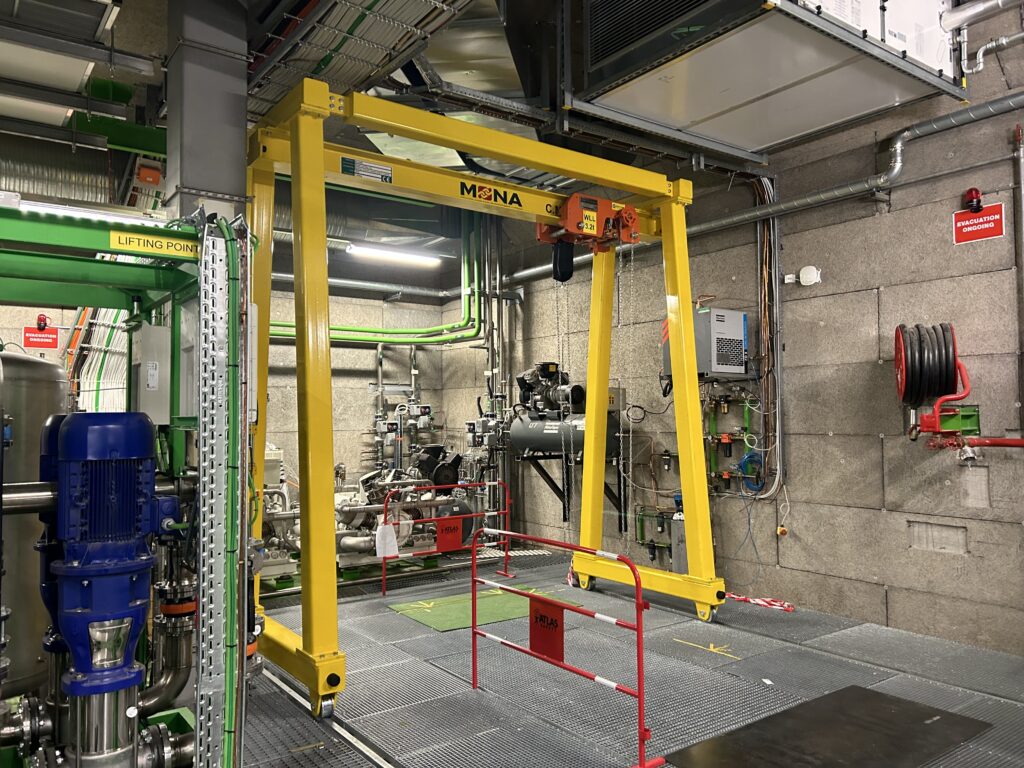
Datrys was commissioned by Mona Group to design a manual gantry crane for CERN’s USA15 Cavern, part of the Large Hadron Collider infrastructure. The crane, required for installing new cooling equipment, was engineered to safely lift up to 3.2 tonnes and be manually moved along floor-embedded guide rails.
Technical: Modular design allows for easy assembly and future maintenance.
People: Collaboration ensured all team expertise was fully utilized.
Value: Robust design supports long-term reliability and performance.
Client
Mona Group
Project Type
Structural Engineering Gantry Crane Design
Date
2023
Location
Cern, Geneva, Switzerland
Our Approach
Datrys developed the structural design and detailing for the crane, ensuring full compliance with EN 15011 and EN 13001 standards.
A 3D structural analysis model was used to calculate forces and deflections, guiding the selection of section sizes to meet strict deflection limits.
Special attention was given to bolted connections for modularity and strength, with close coordination alongside Mona’s mechanical team to align loading scenarios and interface requirements.
The Solutions
The resulting design is a manual gantry crane on four wheeled legs, running on fixed guide rails in CERN’s USA15 area. Its bolted connections allow for straightforward disassembly, transport, and underground reassembly, reducing the need for on-site welding.
The design achieves optimal strength and stiffness with minimal weight, meets stringent deflection requirements and has connections that have been detailed to allow simplified assembly.
This required careful coordination and ensuring alignment with CERN’s operational and safety requirements, while balancing strength, durability, and constructability.
Project Outcome
The crane was successfully fabricated, installed, and load-tested by Mona Group, confirming the design’s performance. It now operates daily, supporting CERN’s upgrade works.
Lessons from this project informed improvements in subsequent crane designs, including the adoption of Autodesk Robot Structural Analysis for more advanced torsion and fatigue evaluation.